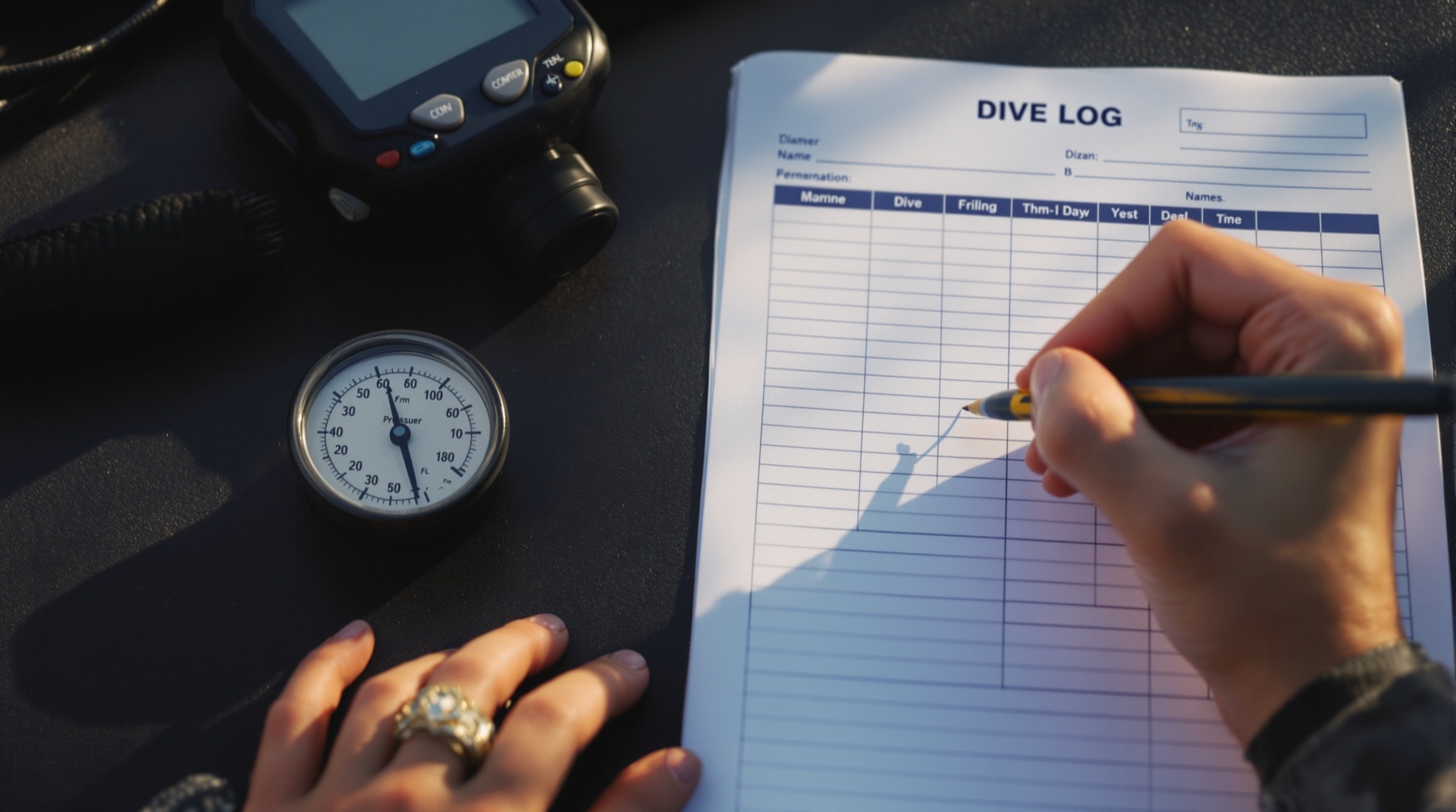
SharkPoint supported more logbook fields than most dive log software of its time, which raised a fair question from divers: which of them actually matter? This page is the answer, written around the record structure the software used but applicable to a paper book or any other program.
The test throughout is simple. A field earns its place if, five or ten years from now, it will either answer a question you will actually ask or reconstruct something you will not otherwise remember.
The core numbers — never skip these
These are the fields the statistics are built from. Leave one out on a dive and that dive is missing from the analysis for good.
- Date and time in — and the time out. Surface interval is derived from these, and so is any repetitive dive reasoning.
- Maximum depth and average depth. Average depth is the one divers most often omit and the one air consumption calculations most depend on.
- Bottom time — and note which convention you are using, consistently.
- Start and end cylinder pressure, together with cylinder size. Pressure alone tells you nothing comparable between a twelve-litre and a fifteen-litre cylinder.
- Gas — air or the mix used. If you dive anything other than air, recording it is not optional.
- Weight carried — the single most useful field for a diver still finding their trim, and the one that saves the most time on the first dive of a trip.
Why average depth keeps coming up
Air consumption rate — normalised to the surface so that dives at different depths can be compared — needs gas used, dive time and average depth together. With all three, a logbook can tell a diver whether their consumption has genuinely improved or whether they have simply been diving shallower. With only maximum depth, it cannot, and the resulting figure flatters or punishes essentially at random. SharkPoint calculated the rate automatically, which is precisely why it wanted the input fields filled in properly.
Conditions
These are what make an old entry legible as a dive rather than a row of numbers, and they are what you will read before returning to a site.
- Water temperature, at the surface and at depth if they differ meaningfully — this drives exposure protection decisions next time.
- Visibility, honestly rather than optimistically.
- Current, and its direction relative to the entry.
- Sea state, weather and entry type — shore, boat, drift.
- Tide, where the site depends on it. For many shore sites this is the difference between an excellent dive and a pointless one.
The people and the place
In SharkPoint these were separate linked records rather than free text, and the reason is worth restating: linked records can be searched, counted and pulled up as a set. Typed names cannot.
- Buddy — who you dived with, as a record rather than a name.
- Dive site — as a record, accumulating notes across every visit, with GPS co-ordinates where you have them.
- Dive school or operation — useful when you are trying to remember who ran a good boat.
- Role — whether you were diving recreationally, guiding, instructing or assisting. Logged roles are what a professional application will ask about.
Fields that look precise but are not
A field can be completely filled in and still be ambiguous. Dates and times are an easy example: a device clock, a local wall clock and a later computer import may not describe the same time convention. When travel or a clock correction matters to the sequence, record the convention and the source rather than silently changing an old entry. The same applies to duration fields. A number labelled only “time” leaves a later reader to guess whether it describes the whole outing, the recorded profile or another interval.
Place names create a different kind of drift. One site may acquire spelling variants, translated names or separate labels for nearby entries. Choose one main site record, keep alternate names as notes and avoid creating a new place merely because the spelling differs. Co-ordinates also need their format and precision preserved. Rounding them for display should not replace the original values, and an empty position should not be filled with an approximate point that later looks measured.
Equipment and units reward the same discipline. A shorthand label that is obvious on the day may be meaningless after the item has been replaced, while a stable description can keep old comparisons readable. Record the unit with any quantity that might be exported without its column heading, and distinguish “not recorded” from zero. A documented uncertainty is more useful than a tidy value whose origin can no longer be explained.
Equipment
An equipment log tracks what you own and when it was last serviced. Recording which configuration you used on a given dive is what makes the weight field meaningful — the same diver needs different weight in a shortie and a drysuit, so a weight figure without an exposure suit beside it is not reusable information.
Service intervals recorded in a logbook are a reminder, never an authority: the manufacturer's schedule and a qualified technician decide when equipment is due, not a piece of software.
Personal records
SharkPoint kept a personal information page for certification, medical and insurance details. Keeping these with the logbook is convenient — they are the things asked for at a dive centre — and it is also the reason the version 2 releases added password-protected files. Treat that part of a logbook as you would any other document holding medical information.
The profile, and what it adds
A dive computer profile records depth against time as it was actually sampled, and it is the one part of a dive that cannot be reconstructed afterwards. Imported through the DCU modules, it sat alongside the entry rather than replacing it — because the computer knows the depths and the diver knows everything else.
Reviewing profiles is genuinely instructive: ascent rates, safety stop discipline and time at depth all show up in a way that memory softens. What to make of what you see is a training and dive-medicine question, and the Divers Alert Network is the place to take it.
What to leave out
Long free-text narratives are the field divers abandon first, because writing them is a chore and searching them is impossible. A few specific notes — what you saw, what went wrong, what you would do differently — are worth more than a paragraph, and they are far more likely to still be there in ten years' time.
See also dive computer imports and log file formats for keeping all of this readable in the long run.